International Quickstep
Also known as: Quick Step, Quick Foxtrot
History & Cultural Context
Dancers modified the Foxtrot by adding quick steps, a light bouncy action, and syncopated rhythms to keep pace with fast jazz tempos. The Quickstep was standardized in England in 1927 -- after Frank Ford and Molly Spain performed a Charleston-free "Quick Time Foxtrot and Charleston" at the Star Championships -- and was subsequently codified by the Imperial Society of Teachers of Dancing as one of the International Standard dances.
Cultural Significance
Its rapid footwork and demanding choreography require both partners to maintain close synchronization at high tempo.
Characteristic Movement & Technique
performed at a fast tempo (approximately 50 measures per minute, ~200 BPM in 4/4 time). The dance features the characteristic 'quickstep hop' or bounce action that creates upward momentum as dancers travel across the floor.
Partnering Dynamics
International Quickstep is danced in closed position with a frame that supports rapid movement and directional changes. The connection between partners is maintained through a firm but flexible frame that allows for clear communication of quick directional changes and weight shifts. The leader guides the follower through rapid movements with subtle frame pressures and directional indicators, while the follower executes quick, precise movements in response to lead signals. Partners work in close coordination to execute rapid footwork patterns and maintain rhythm despite the fast tempo. The partnership is characterized by synchronized movement, clear communication, and the ability to execute complex figures while maintaining energy and musicality. Effective Quickstep partnership requires anticipation, sensitivity to partner movement, and ability to maintain balance during rapid direction changes.
Competitive Context
International Quickstep is one of the five International Standard dances competed at all levels of ballroom competition under WDSF and WDC governance. Quickstep appears at amateur preliminaries through professional world championships. Competitors progress through bronze, silver, and gold levels with increasingly complex choreography at higher levels. Quickstep is often considered the most technically challenging of the ballroom dances due to the rapid footwork and complex choreographic patterns executed at high tempo. Professional Quickstep competition features dynamic, exciting performances that showcase dancers' technical virtuosity and ability to maintain precision under challenging conditions. Judges evaluate technique, choreography, timing, partnership, and presentation, with particular attention to the clarity of footwork and musicality at the fast tempo. Quickstep has produced some of ballroom competition's most celebrated dancers.
Regional Variations
While International Quickstep maintains standardized technique, regional coaching schools develop distinctive approaches to footwork clarity and choreographic construction. British dancers, reflecting the dance's English origins, often emphasize smooth traveling action and classical technique. Eastern European dancers have developed approaches emphasizing very sharp footwork articulation and precise technical execution. Different schools vary in how they construct choreography and which figures they emphasize. Professional exhibition Quickstep often incorporates contemporary music and theatrical elements while maintaining core Quickstep technique. Some contemporary performers explore pushing tempo limits and experimenting with artistic interpretations that expand traditional boundaries. However, core technique and fundamental characteristics remain consistent across regional variations.
Common Misconceptions
A common misconception is that Quickstep is simply 'fast Foxtrot'; while they share some technical elements, Quickstep features distinctive footwork patterns and different movement quality. Another misconception is that Quickstep requires extreme athleticism beyond normal fitness; while demanding, well-trained ballroom dancers can execute it with proper technique. Some people believe that Quickstep should feel rushed or stressful; properly danced, Quickstep projects joyful energy and control. A frequent misconception is that faster Quickstep always scores better; control, choreography quality, and artistic expression matter more than absolute tempo. Finally, people often incorrectly believe that Quickstep is only for young, athletic dancers; dancers of all ages can learn and excel with appropriate training.
Peak Popularity
Signature Figures
- Quick Open Reverse
- Natural Spin Turn
- Heel Turn
- Lock Step
- Chassé
- Tipple
Notable Codifiers
- Imperial Society of Teachers of Dancing
- Victor Silvester
- Josephine Bradley
- ISTD (Imperial Society of Teachers of Dancing)
- WDSF (World DanceSport Federation)
- WDC (World Dance Council)
Dance Lineage
Track Your International Quickstep Progress
Practice International Quickstep figures between lessons with Figure Focus — step-by-step breakdowns, floor diagrams, and progress tracking. Free to use.
Watch International Quickstep
2013 WDSF PD World Standard Final Quickstep — DanceSportTotal
What to Wear
Attire guidance for International Quickstep and other International Standard dances. Each card below is sized to the moment — class, practice, social, or competition — because the wardrobe shifts as the stakes do.
Reading the cards
In Class
Smart practice wear. Women: a practice skirt that moves like a gown, or stretchy trousers. Men: a dress shirt (tucked) and trousers — maintaining frame is easier when dressed for it.
Social Dancing
Formal. Women: long flowing dresses. Men: suit and tie or tuxedo at formal events. Standard socials tend to be dressier than Latin nights.
Competition
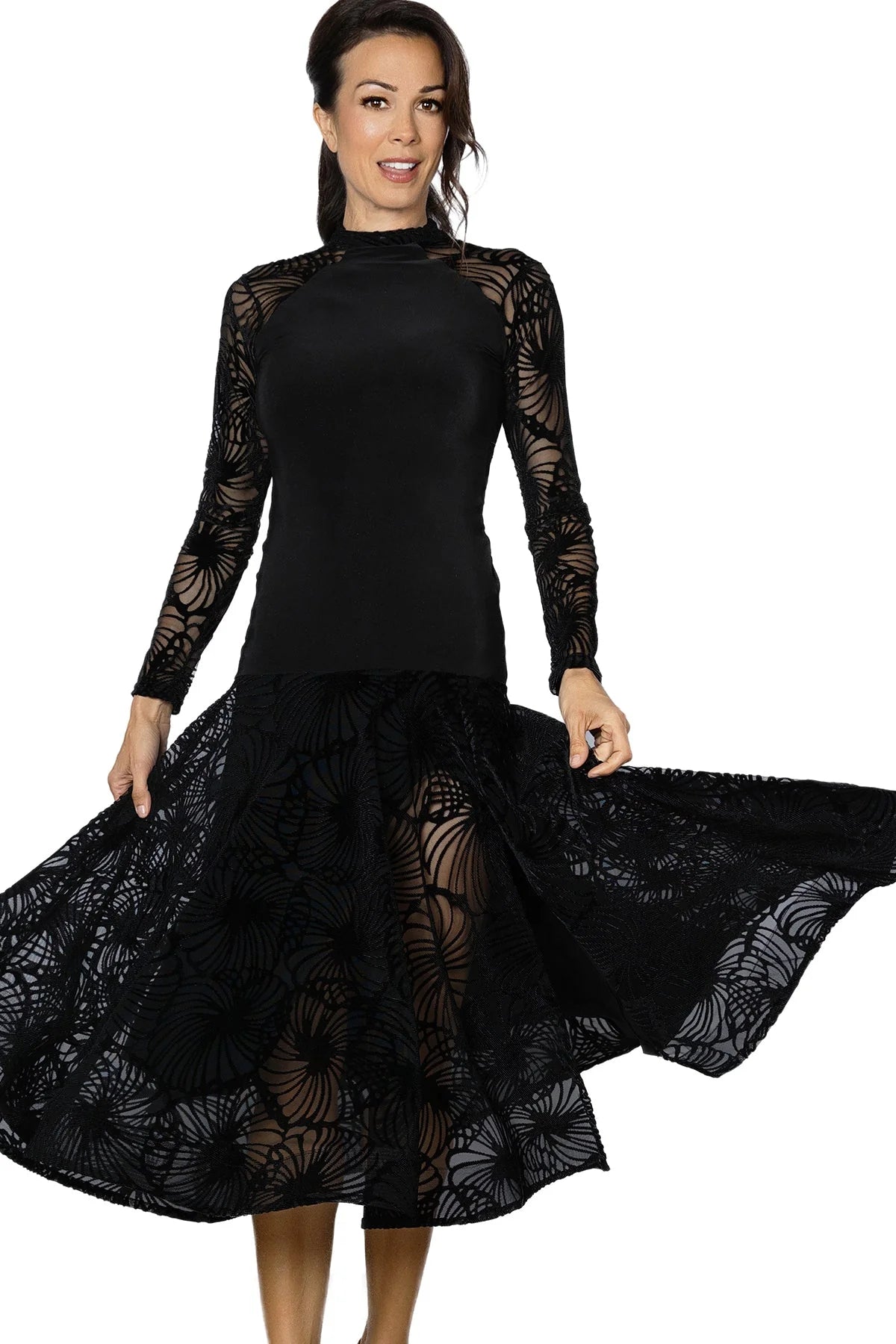
Women: full ballgowns with extensive float, often decorated with Swarovski crystals. Standard gowns frequently feature "wings" — dramatic fabric panels attached at the wrists or arms that create stunning visual lines in the permanent closed hold. Wings work beautifully here because Standard never breaks frame. Men: custom-made tailsuits (white tie) with built-in stretch, specifically constructed for ballroom movement. These are not regular formalwear — a competition tailsuit is engineered for full range of motion in frame. The aesthetic is regal and disciplined.
Shoes
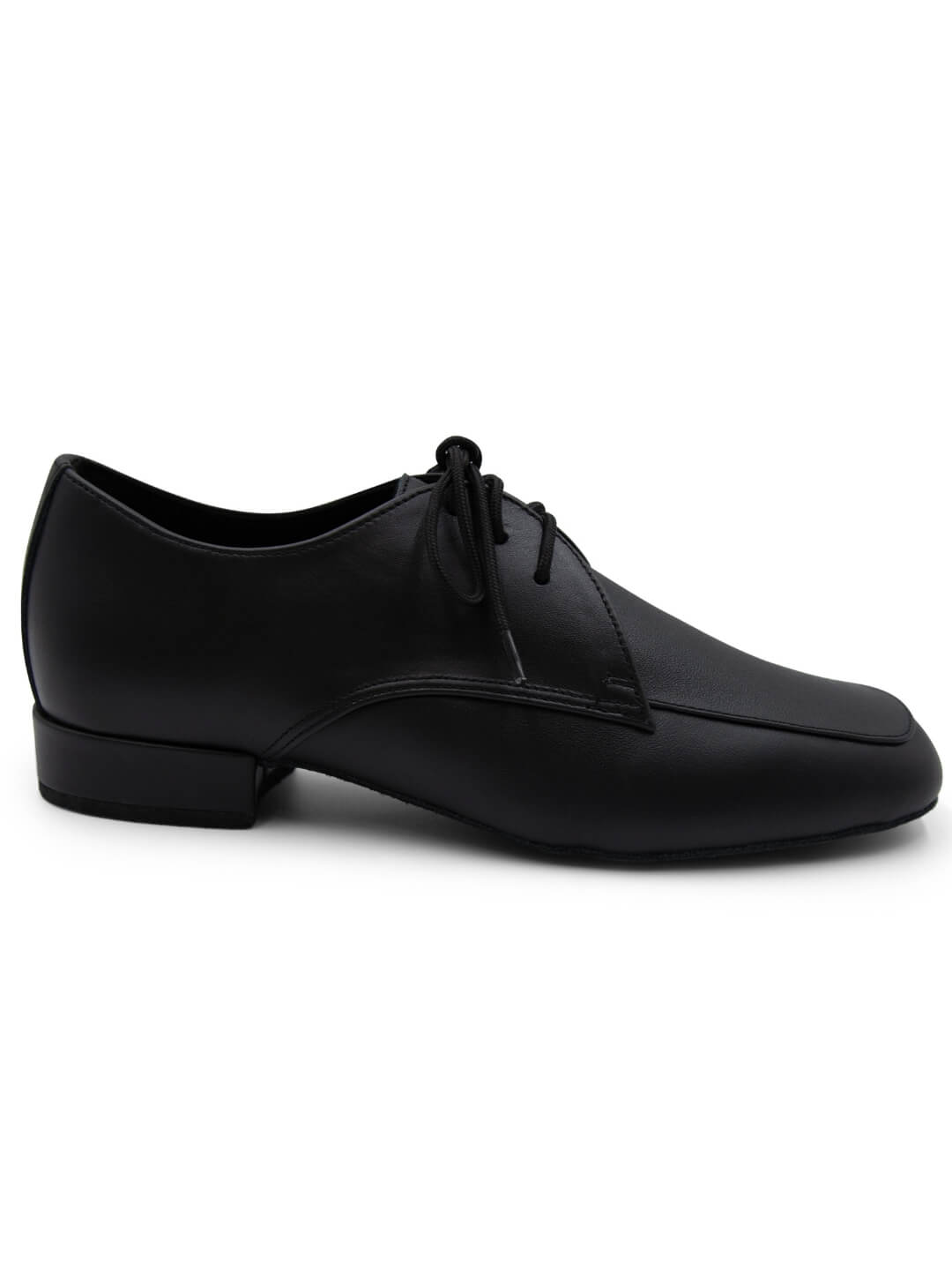
Women: closed-toe court shoes, 2–2.5" heel, flesh-toned or matching gown. Men: patent leather ballroom shoes with 1" heel. Suede soles for smooth movement.
In Practice
Smart practice wear that rehearses the line. Followers in a long practice skirt with real float so the gown becomes second nature. Leaders in a tucked dress shirt and trousers — frame discipline is easier when you are dressed for it. Many serious Standard couples train in light gloves to rehearse hand placement.
By Role
Leaders
Class: Tucked dress shirt and trousers. A practice vest helps lock the frame.
Competition: Custom tailsuit (white tie). Tailcoat with stretch panels in the back, under the arms, and along the trouser seat. Shoulders constructed slightly forward of neutral so seams sit correctly when arms come up. White waistcoat, white bow tie, suspenders (never a belt — a belt creates a horizontal break and shifts mass during movement). High-waisted trousers. Patent leather oxfords with 1" heel and suede sole. The aesthetic is consciously archaic — a callback to the Vienna and London ballrooms where these dances were codified.
Followers
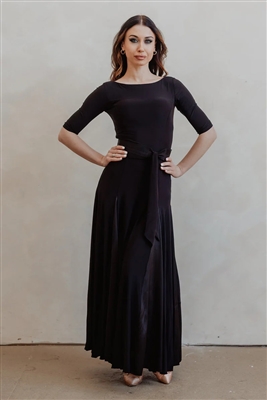
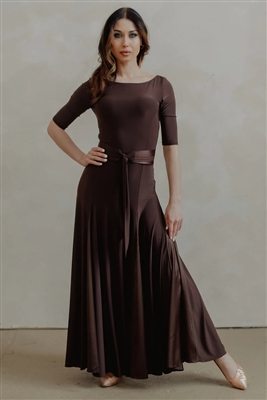
Class: Fitted leotard or top with a practice gown skirt — long, soft, and weighted enough to teach gown management.
Competition: Long ballgown with extensive float and frequently with wings — large fabric panels attached at the wrists or upper arms creating a continuous line from fingertip to fingertip. Wings work in Standard for one reason: the frame never breaks. Heavy decoration: Swarovski rhinestones, pearls, occasional feather trim. Color skews dramatic — black, royal blue, deep red, ivory — for visual clarity at distance. Hair pulled back, often a chignon.
Tailsuit vs Smooth Suit · Wings vs No Wings
International Standard vs American Smooth
International Standard
- ◆Leader: Tailsuit (white tie). Tailcoat with stretch panels — not a tuxedo.
- ◆Follower: Ballgown with wings — fabric panels at wrist or upper arm.
- ◆Frame: Permanent closed hold — wings work because frame never breaks.
American Smooth
- ◆Leader: Smooth suit — stretch dance jacket, often without tails.
- ◆Follower: Ballgown without wings — arms must be free to leave the frame.
- ◆Frame: Opens for tandem walks, shadow positions, and free turns.
International Standard's wardrobe is the most architecturally specific in competitive ballroom because Standard's geometry is the most uncompromising. Permanent closed hold means tailsuit + winged gown create one sweeping shape moving as a single object. American Smooth, by contrast, opens the frame for tandem walks, shadow positions, and free turns — which is why Smooth uses a smooth suit (not a tailsuit) and a wingless gown. Putting a Standard tailsuit on a Smooth competitor — or a Smooth suit on a Standard competitor — gets the wardrobe wrong in both directions.
Common Pitfalls
- ✗Wearing an off-the-rack tuxedo to a Standard event — the single most expensive mistake a beginner can make. Shoulders bunch, chest tightens, frame collapses inward.
- ✗Substituting a Smooth suit for a tailsuit — the genres look similar from a distance and demand different garments.
- ✗Wearing rubber-soled shoes — they grab the floor and load the knee during heel turns.
- ✗Skipping suspenders for a belt — breaks the visual line and shifts trouser position during movement.
Price Range
- Budget: Practice skirt and shirt-and-trouser kit $150–300; entry-level Standard shoes $90–160.
- Mid: Off-the-rack tailsuits and gowns $1,500–4,000; mid-tier shoes $180–280.
- Premium: Bespoke tailsuit (Chrisanne Clover, DSI London, Aida) $2,500–5,500; competition gown with full crystalwork and wings $5,000–15,000+; premium patent leather ballroom shoes $300–450.
Key Terms
- Tailsuit
- Custom-engineered tailcoat with stretch panels and movement-aware shoulder construction. White tie, white waistcoat, black tailcoat. Not interchangeable with a normal tuxedo.
- Wings
- Fabric panels attached at wrist or upper arm extending the gown's silhouette outward. Possible in Standard because the closed hold never breaks.
- Float
- Multiple layers of soft fabric in the skirt that travel through the air in a controlled wake.
- Suspenders, not belt
- A belt creates a horizontal break in the line and shifts mass; suspenders preserve a continuous hip-to-shoulder silhouette.
Quick Tips
- •Suede-soled shoes allow controlled sliding and pivoting — essential for most partner dances.
- •Avoid rubber soles on dance floors; they grip too much and can cause knee injuries.
- •Bring a separate pair of clean shoes for the dance floor to keep it in good condition.
Recommended Gear for International Quickstep
Essential equipment and apparel selected for dancers learning International Quickstep.
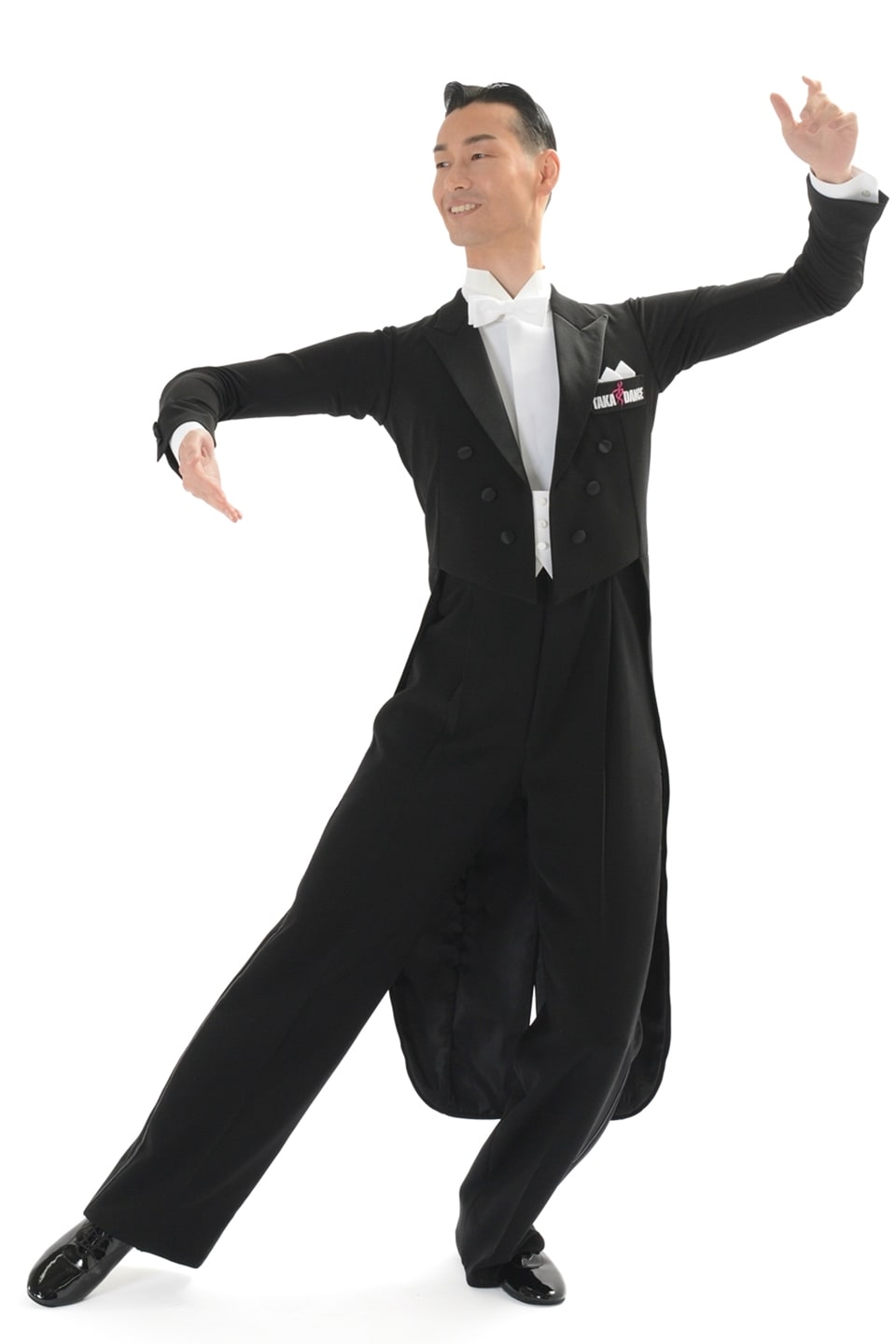
International Ballroom | International Standard Tail Suit | Tales | For Men | RA01 | Taka Dance
Taka Dance
$400+
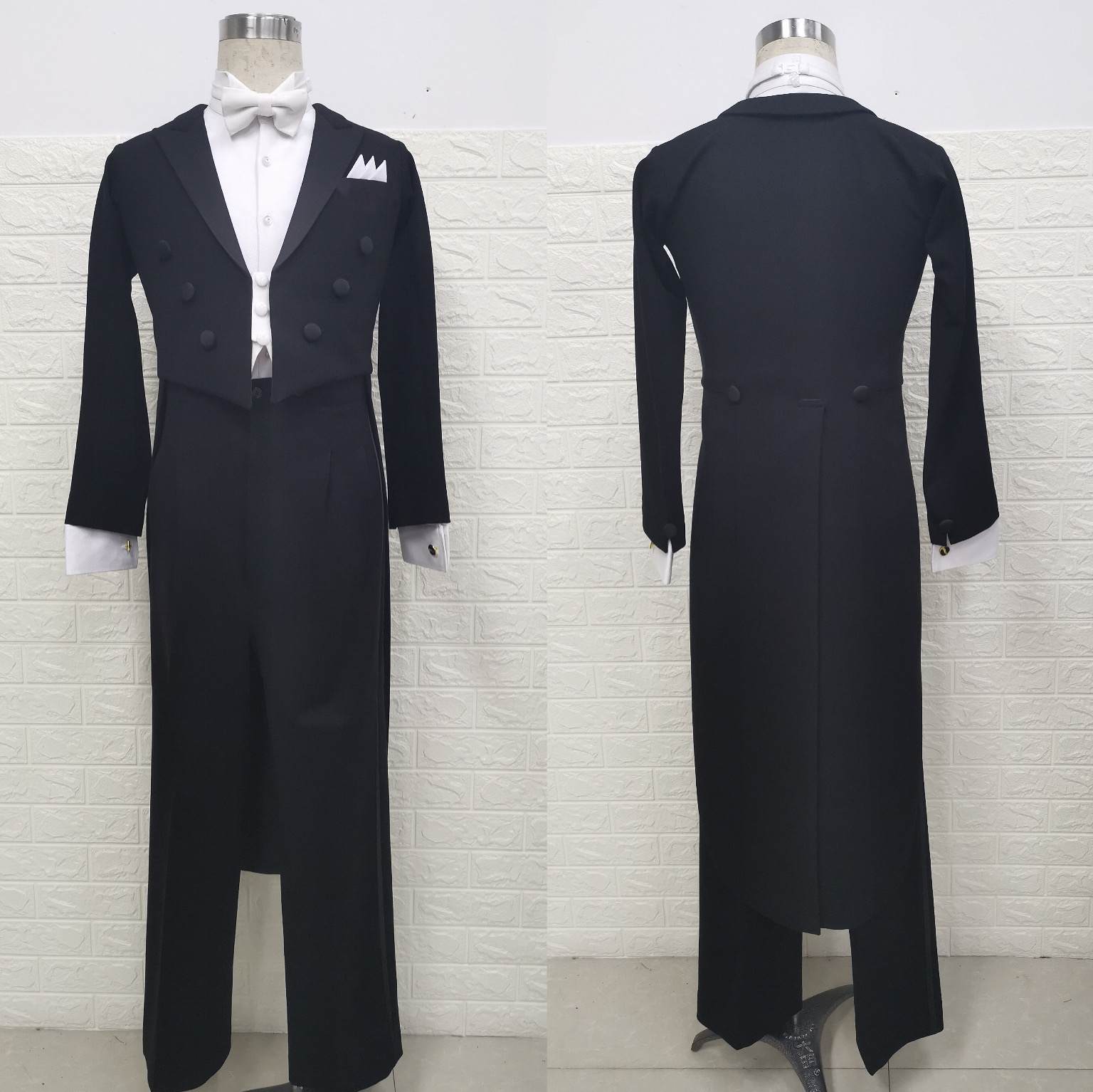
Steps & Threads Mens Ballroom Dance and American Smooth Tail Suit with Shirt
Steps & Threads
As an Amazon Associate, LODance earns from qualifying purchases. Affiliate disclosure
Sources & Further Reading
Syllabi (instructional standards, not citable sources)
Competitive technique and choreographic standards are maintained by:
- • ISTD (Imperial Society of Teachers of Dancing) and WDSF (World DanceSport Federation) official syllabi and technique manuals
- • DVIDA (Dance Vision International Dance Association) materials for American dance variants
- • USA Dance and other national governing body resources
- • WDC (World Dance Council) competition rules and adjudication standards
Cultural & Historical Context
International Quickstep emerged from England during the 1920s—1930s. Understanding the cultural roots, musical traditions, and social circumstances of this era enriches appreciation for the dance's characteristics and significance.
Formative Influences
Codifiers & Standardizers:
Imperial Society of Teachers of Dancing, Victor Silvester, Josephine Bradley, ISTD (Imperial Society of Teachers of Dancing), WDSF (World DanceSport Federation), WDC (World Dance Council)
Signature Movement Vocabulary:
Quick Open Reverse, Natural Spin Turn, Heel Turn, Lock Step, Chassé, Tipple
Primary Source Documents
The Library of Dance contains public-domain primary sources for dance history. Copyrighted modern syllabi are indexed with purchase links to their respective copyright owners. Search by dance name or codifier to discover primary source documents.
Last reviewed: July 2026 — This dance profile synthesizes historical research, cultural documentation, and contemporary practice knowledge to provide authoritative context.
More in International Standard
International Waltz
The waltz emerged in late 18th century Vienna, evolving from the Austrian Laendler. It revolutionized ballroom dancing by introducing the closed couple position and three-quarter time signature. The dance became a symbol of elegant courtship and romantic expression throughout the 19th century.
International Tango
It was codified for International Standard competition by the Imperial Society of Teachers of Dancing in the 1920s, and is characterized by staccato rhythms, sharp movements, and dramatic styling.
International Viennese Waltz
The Viennese Waltz is the faster, more rotational precursor to the Modern Waltz, characterized by rapid continuous turning and minimal use of other figures. It originated in early 19th century Vienna and remains closely associated with Viennese balls and tradition.
International Foxtrot
The Foxtrot emerged in the United States in 1914, derived from the one-step and danced to syncopated ragtime and early jazz. It became one of the most popular ballroom dances of the early 20th century, known for its smooth, traveling action.
What did dancers wear?
International Quickstep belongs to the Modern Competition (1950s–present) era. See how attire shaped the choreography — and the other way around.
Explore Modern Competition attire →Our Library of Dance corpus skews to historical public-domain sources (pre-1925). Modern competitive technique citations require additional rights-cleared sources — see roadmap.
Continue Exploring
Lineage of Dance
Explore 500 years of dance evolution
Champions of Dance
Winners of marquee national & world titles
Language of Dance
400+ dance terms & translations
Listening of Dance
Tempo, timing & musicality tools
Gallery of Dance
1,200+ public domain artworks
Attire of Dance
Evolution of dance dress across eras